 PodcastCodex
How to Remember Characters in a Fiction Podcast
Fiction podcasts deliver names as sound with no page to flip back to. Habits that help, where they break at scale, and a spoiler-safe way to look anyone up.
 ForgeAppsOctober 2, 20267 min read
You can love an audio drama completely and still blank, mid-scene, on who the quartermaster is. Fiction podcasts ask more of memory than almost any other medium: names arrive as sound with no spelling attached, episodes arrive weeks apart, and you are usually doing something else (driving, walking, cooking) while they arrive. Forgetting characters in a fiction podcast is not a listening failure; it is how auditory memory works. The fix is part habit, part tool, and it scales differently than most advice assumes. This piece covers both halves: habits that cost nothing, and the kind of lookup that carries you past the point where habits stop working.
Start with why audio makes this harder than reading. Page readers get three hooks listeners lose: the visual shape of a name in print, spatial recall of roughly where a detail appeared, and the ability to slow down on a dense introduction paragraph. Audio strips all three. A long audio drama compounds it: hundreds of episodes, casts the size of novels, characters referenced by title or epithet as often as by name. A name heard once in episode twelve carries almost nothing into episode forty unless something anchors it. A reader who blanks can scan back two paragraphs; a listener who blanks can rewind and hope.
Is forgetting characters a listening failure?
What memory advice gets wrong
Real fans just pay closer attention
Attention is not the bottleneck. Encoding is. A name heard once, with no visual form and no context hook, has almost nothing to stick to no matter how hard you were listening.
Distinct voice actors make characters easy to track
Casting helps during dialogue scenes, but shows narrated by one voice still blur, characters get discussed for episodes before they appear, and thirty voices across two hundred episodes blur anyway.
If you cannot keep the cast straight, the show is badly written
Long serials are built on conventions borrowed from novels. They assume you can flip back or consult a reference. Nobody's unaided auditory memory is sized for a three-hundred-episode cast.
What habits actually help, with no tools at all?
The workarounds that genuinely help all attack the encoding problem: they give a name something to stick to while it is still fresh. None of them require an app, and all of them are worth doing even if you later add one.
Tool-free habits worth building
- Anchor each new name to one concrete fact (a role, a debt, a specific moment), not a vague impression of the voice
- Read the episode description before pressing play; cast lists prime your ear for the names that are coming
- Give introduction episodes your undivided attention or slower playback; first appearances carry disproportionate weight
- After any gap, replay the last minute of the previous episode instead of starting the new one cold
- When a heavy arc starts, keep one line per major character in a notes app: who they are and what they want
- Hold a steadier cadence where you can; weekly gaps erase minor characters faster than they erase plot
These habits work at season-one scale. They break at serial scale. One-line notes are safe from spoilers but they are a second job: maintained during commutes, searched mid-dog-walk, useless the week you forget to update them. And notes only answer the questions you predicted. The name that resurfaces at episode 210 is always the one you never wrote down. Season gaps sharpen it further. A show that returns once a year asks you to hold an entire cast dormant for eleven months.
How do you look someone up without spoiling yourself?
The scalable answer is a lookup that knows where you are. Searching a character's name online fails not because it is effortful but because fan wikis are written from the ending, a trap we dissect in why podcasts need spoiler-safe wikis. A reference that cannot spoil you has to be gated to your playback position, which is what the codex in PodcastCodex does. The mechanics are in the codex explainer. Gating matters as much as lookup speed, because the fastest spoiler is still a spoiler. The practical workflow looks like this.
A lookup that cannot spoil the story
- 1
Keep the lookup inside the player
Every external search is a dice roll. In PodcastCodex the answers live in the same app as the play button, so there is no autocomplete offering 'Maren (impostor)' while you are mid-season.
- 2
Check In This Scene first
The Now Playing screen keeps a live strip of the names relevant to the current scene. Most 'who is that' moments get answered there without any searching at all.
- 3
Read the entry, not the internet
Each codex entry reveals only what the show has narrated before your playhead: mentions, first heard, last heard. A reveal you have not heard does not exist on the page.
- 4
Rebuild context after a break
The Previously On recap summarizes the story up to your position. Two minutes before a new episode beats twenty minutes of guessing, and it cannot leak ahead.
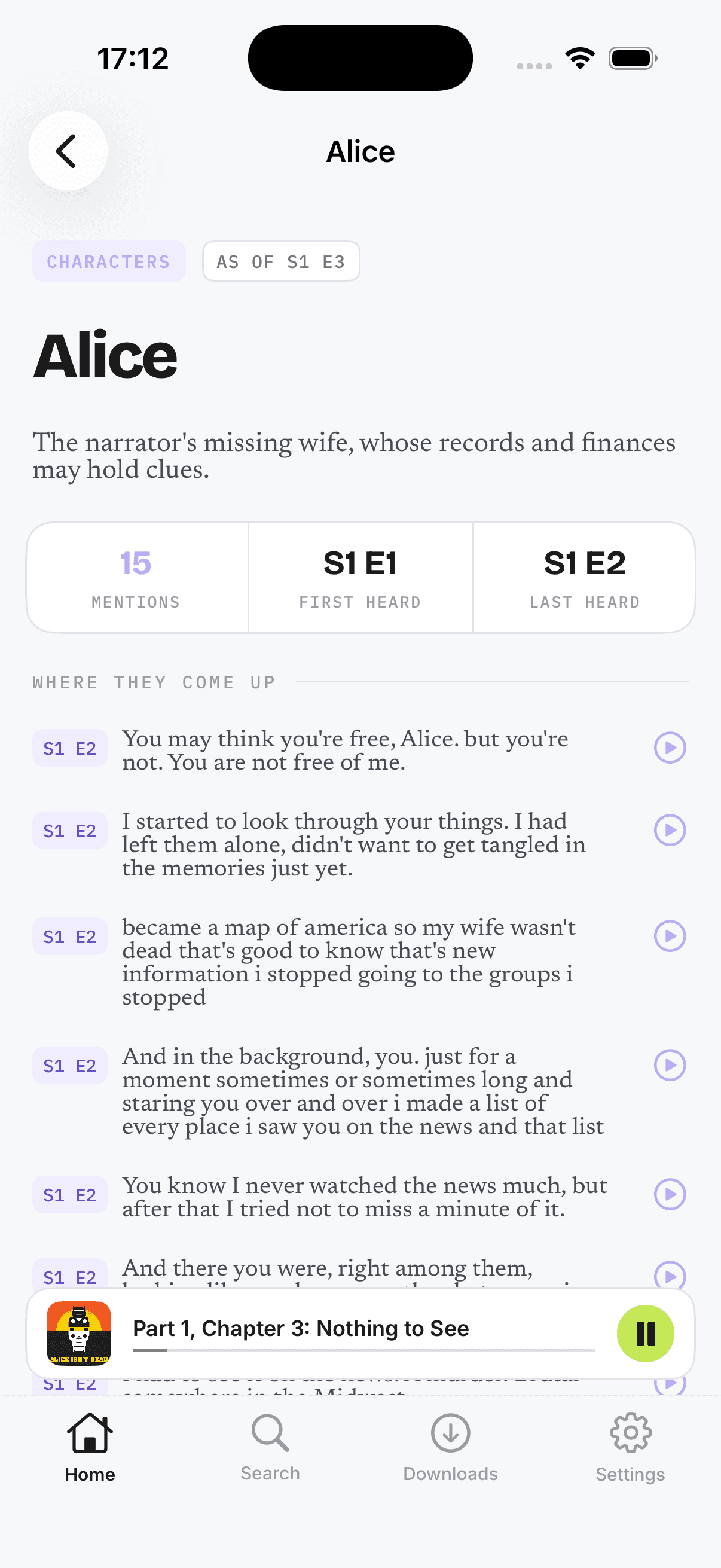
Picture the moment this is all for. Two hundred episodes into a serialized drama, a name returns: Captain Ilya Voss, last heard surrendering a harbor at the end of season two. The dialogue treats the name as a punchline the audience should already get. Your notes app has nothing: you wrote three lines in month one and abandoned the habit by month two. A wiki would answer in one search and several spoilers. Inside the player, the name is already sitting in the In This Scene strip, and its entry shows first heard, last heard, and the mentions between them, right up to your playhead, where it stops. That is the difference between remembering characters with a tool and being graded on remembering them without one.
Do not underestimate the transcript, either. Names arrive as sound; a timestamped, searchable transcript that follows playback gives them a spelling, and spelling is the hook memory wants. Hearing 'Maren' and seeing Maren land in the same second is often all the anchor a minor character needs. It also makes rewinding sane: when you missed the line that introduced someone, you search the name instead of guessing at a timestamp.
Character-memory questions
Is it normal to forget who podcast characters are?
Completely normal. Audio gives names no visual form and episodes arrive across weeks; shows with novel-sized casts exceed unaided auditory memory by design, not by your failure.
Will a codex entry spoil reveals I have not heard?
No. Entries are gated to your playback position. An entry knows only what the show narrated before your playhead, and it unlocks more automatically as you listen.
What if my show has no codex coverage yet?
It still plays normally in PodcastCodex, and you can wish for coverage in the app; wishes are how coverage is prioritized. Meanwhile the habits above carry the load.
Do I need an account to track anything?
No account and no sign-up. Add a show by RSS URL or directory search and start listening.
Attach every new name to a moment, not a description: 'the one who burned the ledger' survives for weeks; 'the gruff one' does not. And when the moment itself will not come back to you, that is precisely what the codex entry is for.
Remembering podcast characters is a habit problem up to a point and a tooling problem after it. PodcastCodex is free to try on the App Store. The first five episodes of a supported show carry the full codex, which is exactly where the forgetting usually starts.
Keep the story clear
Try PodcastCodex for free.
Listen to any serialized show with a spoiler-safe story codex that stays exactly at your position.
 Download on theApp Store
 Coming soon toGoogle Play