 PodcastCodex
Why Fiction Podcasts Need Spoiler-Safe Wikis
Fan wikis are written by people who finished the show. Here is how they spoil you, why the workarounds fail, and what spoiler-safe design requires.
 ForgeAppsSeptember 4, 20267 min read
You are fifty episodes into a fantasy audio drama when a name resurfaces: the envoy who appeared twice in season one and then vanished. The show clearly expects you to remember her. You do not. So you do what everyone does. You open the show's fan wiki, search her name, and read the first line of her page: 'Elira Voss (later revealed as the Warden's double agent; deceased).' In four seconds you have traded a small confusion for three seasons of ruined suspense. That is the fan-wiki trap, and it is the default experience of following any long serialized fiction podcast.
None of it is malice. A wiki is a reference work, and reference works are written backward from the ending. The people editing that page finished the show months ago; their job, as they understand it, is to state the final truth as clearly as possible. That makes fan wikis magnificent resources for a completed series and actively hostile ones for a listener still living inside the story, and mid-story questions are the most common kind. 'Wait, who is that again?' is not trivia. It is the tax serialized audio charges every single listener.
How does a fan wiki spoil you without meaning to?
A wiki article is engineered so the most complete answer sits highest on the page. Each layer of a normal lookup is a different kind of spoiler, and none of them require you to click anything you were warned about.
An ordinary wiki lookup, step by step
- 1
Autocomplete guesses ahead
You type 'Mar' to check a marshal's name and the suggestions offer 'Maren (impostor)' or a ship name pairing her with a man she has not met yet. The search box itself leaks.
- 2
The infobox leads with the ending
'Status: Deceased.' 'Affiliation: the Ashen Court', the faction she publicly joins in season five. 'First appearance' is safe; 'Last appearance: Episode 212' is not, because now you know she is gone by then.
- 3
The lede compresses the whole arc
Opening paragraphs are written to summarize a life, so betrayals, marriages, and secret identities land by sentence two, long before any spoiler tag could possibly sit.
- 4
Section headings narrate the plot
You scroll toward 'Early life' and pass 'The betrayal at the gate,' 'Imprisonment,' and 'Death' in the table of contents on the way down.
- 5
Nav boxes and categories finish the job
The footer files her under 'Members of the secret council' (a council you did not know existed), and the nav template seats her between two characters helpfully marked 'formerly.'
Notice what is missing from that sequence: a decision. You never clicked 'show spoilers.' Every layer arrived by default, because efficient disclosure of the final truth is what a reference page is for.
Why do the usual workarounds fail?
Workarounds that sound better than they work
Just don't scroll: read the first line only
The first line is where spoilers concentrate. Infoboxes and ledes exist to give completists the final answer fast, which is exactly what you cannot afford to see.
Wikis mark spoilers, so heeding the warnings keeps you safe
Spoiler tags protect the newest season at best. An article written after the finale treats the entire run as fair game, and the markup was built for a show with one ending, not a podcast with nine seasons.
Ask the fan community instead of searching
A well-run Discord or subreddit is safer, but it is slow, it requires explaining precisely where you are in the show, and one careless reply or thread title defeats the whole exercise.
Finish the show first, look things up later
Serialized shows run for hundreds of episodes across years. 'Later' means spending the entire live story slightly lost: the problem you were trying to solve in the first place.
What would a spoiler-safe wiki have to do?
Strip the problem to first principles and a spoiler-safe reference needs four rules. First, entries are anchored to story moments: an entry exists because a name mattered at a specific point in the show, not because a fandom documented everything about it. Second, the content is gated to the reader's position; the page cannot reveal what you have not heard. Third, entries unlock automatically as you progress, because any system that asks the reader to guess which articles are 'safe' has reinvented the trap. Fourth, summaries are bounded: they describe what the story has established so far, not everything that will ever be true. A profile written inside these rules cannot mention a betrayal from season seven while you are standing in season three, not because it is polite, but because that fact does not exist from where you sit.
That design is easier to describe than to build, because it means someone has to do the wiki's work once per show, from the audio itself, keyed to the listener's position. For iOS listeners it is exactly the gap PodcastCodex's codex was built around.
How PodcastCodex builds a wiki that cannot spoil you
PodcastCodex's codex is an encyclopedia of characters, places, and terms per show, and every entry is anchored to the moment it first matters in the story. The hard rule mirrors the design above: an entry only reveals what the show has narrated before your playback position. Ten episodes in, the codex knows ten episodes' worth. If the kindly quartermaster is unmasked in the finale, your mid-season entry still says quartermaster, because from where you are standing that is the truth. Entries unlock more detail automatically as you listen. No spoiler switches, no honesty policy.
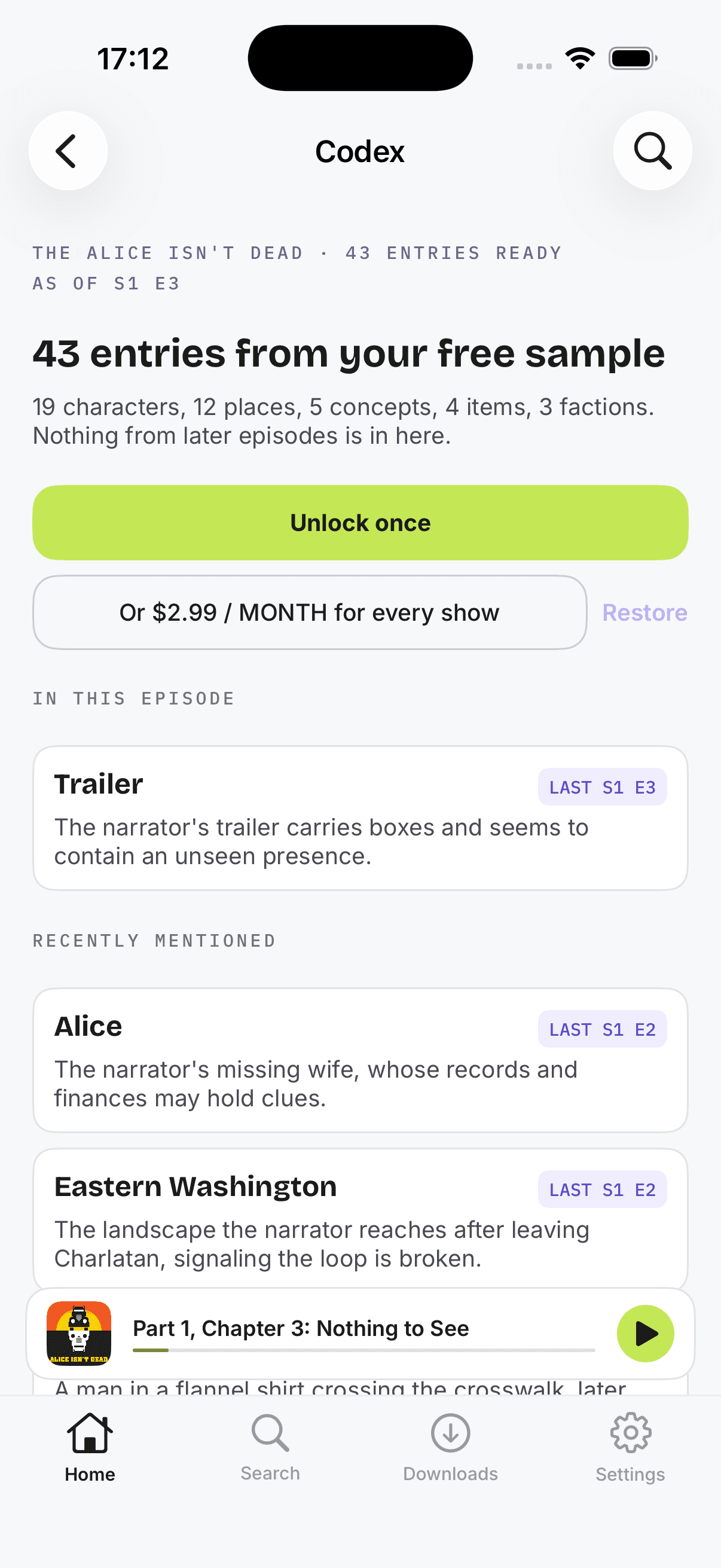
Each entry page is built for the question that actually sent you to a wiki: 'who is this again?' It shows mentions across the show, first heard, and last heard: a breadcrumb trail of a name's history that stops at your playhead. On the Now Playing screen, an In This Scene strip keeps the currently relevant names visible while you listen, and a timestamped, searchable transcript gives names a spelling (half the battle of remembering podcast characters at all). Coming back after a gap, the Previously On recap rebuilds context from before your position, the same workflow we detail in catching up on a podcast after a break.
Coverage comes from server-side analysis of public episodes, so the codex improves over time without any work on your phone, and in-app wishes drive which shows get covered next. A show without coverage still plays normally (the codex is a layer, not a lock), and private feeds never leave your device.
Spoiler questions, answered
Can I use a fan wiki safely if I am careful?
Care does not help, because the spoilers sit in the parts you read first: autocomplete, infobox, lede, section headings. 'Careful wiki use' is nearly a contradiction: the page is optimized to spoil efficiently.
Does the codex cover every podcast?
No. Coverage comes from server-side analysis of public episodes and is prioritized by in-app wishes. Uncovered shows still play like any other episode in a full-featured player.
What happens to an entry after I hear a big reveal?
It unlocks. Gating is tied to your playback position, so once the show narrates a twist, the entry reflects it, automatically, mid-listen, with nothing for you to manage.
Do private or paid feeds get analyzed?
No. Private feeds you add by URL stay on your device and are never sent for analysis.
Treat 'who is that?' as a reason to open the codex, not a browser. If your show has coverage, the answer already exists at your playhead; if it does not, file a wish and keep listening. A delayed answer costs less than a spoiled season.
The wiki your favorite fiction podcast deserved was never going to be written by its fandom; it had to be built against your position in the story. PodcastCodex is free to try on the App Store.
Keep the story clear
Try PodcastCodex for free.
Listen to any serialized show with a spoiler-safe story codex that stays exactly at your position.
 Download on theApp Store
 Coming soon toGoogle Play